


Pervious Concrete and Maintenance - Your Questions Answered!
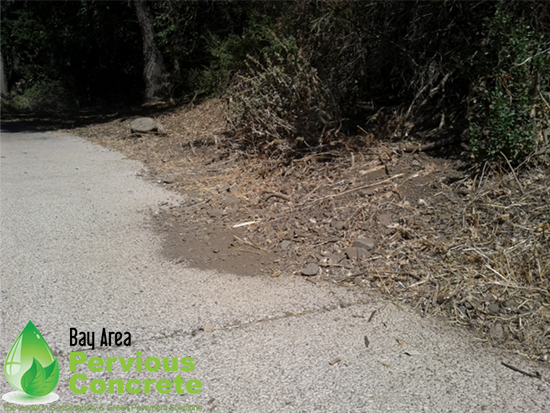
Recently, maintaining pervious concrete has come up several times in a week, prompting this blog post. The good news is that this conversation is happening. The bad news is that some people who are not on board with pervious are using an ill-informed maintenance opinion to shape their judgement. We here at Bay Area Pervious Concrete would like to clear up a few of the misconceptions around maintenance.
Firstly, we have found the relevance of maintenance is tied directly to the porosity of the slab itself. A healthy infiltration rate for a slab of pervious concrete is 250-1000 inches per square foot per hour. That ensures that even if the slab was 99% clogged, and the 5 year storm event was 3 inches in 24 hours (as we have here in the Bay Area), that slab would easily be able to absorb that entire storm. So at 99% clogged, the slab would take in 2.5 inches - 10 inches of stormwater per hour per square foot!
Secondly, here are three helpful resources to help with installing a good slab, maintaining it and the fixing a worst case scenario:
1) In order to make sure you get your healthy infiltration rates, an experienced and qualified contractor is required. We have performance based specs that you may review, so that you can be sure to get a good contractor and get a great pervious concrete installation! We also have a BAPC PolishedTM Pervious Spec that we will send at your request.
2) Regular maintenance that can be done, if there is a budget and a desire for a plan. We have put together a maintenance manual that we give to clients at their request when we finish work for them. This gives an idea what you can anticipate, allows one to set up a maintenance schedule, and has resources to call if clogging does occur.
3) Pervious concrete can recover porosity after clogging over years as shown from a research paper from Florida that came out a few years ago. The paper shows several slabs of unmaintained pervious ranging in age from 6 to 20 years old that were able to recover significant infiltration after a pressure washing, vacuuming or a combination of both - after YEARS of neglect. So, no maintenance, no problem!
Do you have any unanswered questions about maintenance and pervious concrete? Submit them here, and we may add them to this post!
Pervious Concrete Protects Trees!
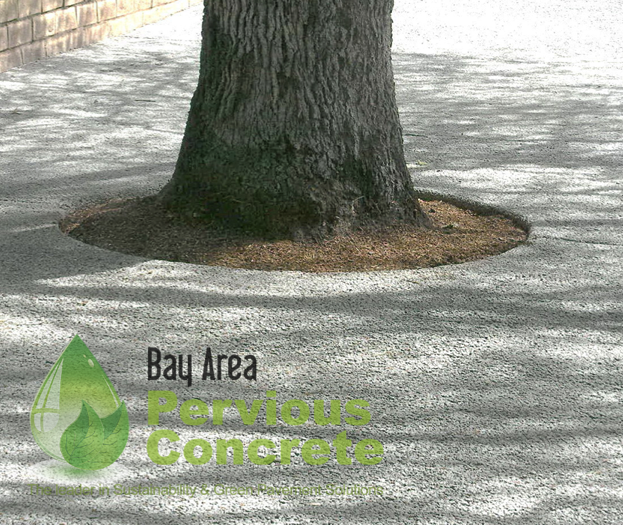
Normally, it is inadvisable to pave inside the drip line* of a tree. Depending on the size and age of a tree that can be a fairly sizable area. This can be problematic when traffic or use requires paving close to the tree. When traditional impervious pavements are installed near older established trees, it can spell the end of the tree. Is that true of pervious concrete?
It turns out there are two students at Texas A&M are doing this very research! Their recent work reveals pervious concrete does, in fact, enhance the growing conditions of established trees relative to traditional concrete. They poured traditional concrete around a few established trees, pervious concrete around a few established trees and left a few trees with no cover for the control, and measured tree health for a little over a year. The results: the trees surrounded by the pervious concrete had more trunk growth during the year then the trees surrounded by the traditional concrete!
What does this mean for you? The good news is that you can integrate pervious concrete paving into plant friendly parking lots and hardscape design, knowing that you are not compromising tree health. This also may open previously impossible parking or other paving possibilities due to the ability to extend the pervious concrete closer to the tree, well within the drip line. Yes, it can make installation tricky, but it can be done!
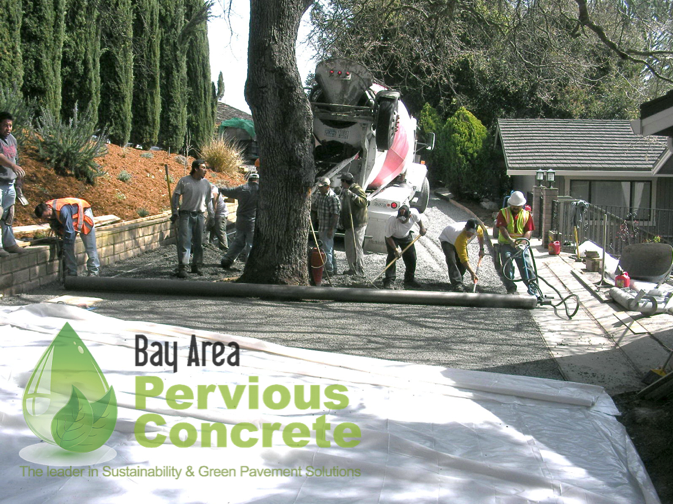
The takeaway is that pervious concrete is great for protecting mature trees. As you can see above, our clients think so too!
*If you are like me, you may have never heard of a tree's drip line before. The drip line refers to the outermost point of the tree's canopy where rain water runoff drips onto the ground below. With a large tree, that may extend many feet out from the trunk. Here is where I found this out.
Volder, A. & Watson, T. (in preparation). "Effect of porous concrete on diameter growth and gas exchange of mature American sweetgum (Liquidamber styraciflua) trees".
2 Symptoms of Failed Pervious Concrete - Raveling and Sealing
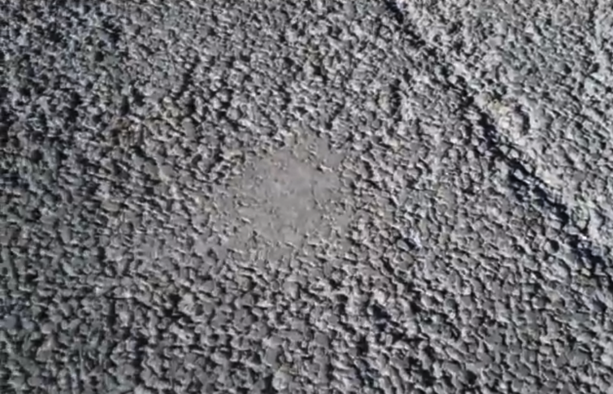
Recently it has come to our attention that there appears to be a discrepancy in what a high-quality pervious concrete jobs looks like, and what has been passed off as high quality but in fact is not at all quality.
Failed installations have 2 main features: raveling and sealing.
Raveling is when the aggregate comes off of the slab as cement coated gravel. That can be an indication of poor mix design, poor installation technique or even misunderstand the weather's impact on the day of the pour.
Sealing is when the water pools and does not go through. It is possible to have sealing at the top, where it looks blotchy, or just beneath the surface such that the finish looks appropriate but does not drain. This is an indication of poor mix design. An experienced pervious concrete installer understands how critical the proper mix is and works closely with his ready-mix partners to get it right.
As we at BAPC have said before, pervious concrete is a tricky material and only those who are qualified, experienced and show a commitment to ongoing learning about techniques and mix designs are able to install and place pervious concrete with a consistent high quality.
We have created this video, complete with an amazing sound track, to illustrate what failed pervious concrete looks like, and what successful pervious concrete looks like. If you would like us to come out and evaluate your slab, or better yet, if you would like it done well the first time, please contact us.