


Project Planning
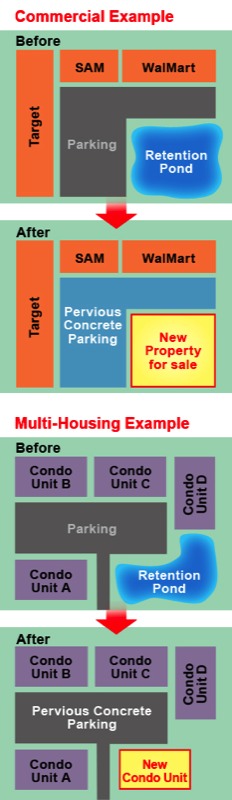
We would like to help design professionals ramp up their pervious concrete design capacity by keeping in mind some of these aspects of pervious concrete:
- Stormwater planning doesn’t require detention ponds, bio-swales, or infiltration trenches when all of the hardscape can function as an infiltration bed when using pervious concrete. In order to precisely design a pervious concrete storm water management system, we use dynamic system modeling.
- Similarly, drainage pipes, curbs, slopes, and layout can be adjusted because there is no longer surface flow when incorporating pervious concrete as the hardscape.
- Pervious concrete is the most affordable of the Low Impact Development Best Management Practices (LID BMPs) due to the fact that generally hardscape is in the budget, and now the parking or EVA can function as a BMP as well.
- When planning for landscaping, it is possible both to leverage the porosity of the pervious concrete as a means of capturing irrigation water, and also, a way to pave safely closer to existing trees without starving them of the necessary air and water, while increasing usable hardscape area.
- When noting the Life Cycle Costing for projects, pervious concrete, like all concrete products, have a lower Life Cycle Cost then asphalt. While asphalt has a lower installation cost, there is far more surface maintenance in order to maintain the hard durable surface over the course of its useful life. With concrete, it is installed and can be left for decades. Some maintenance can be done to ensure surface porosity, but it is rare, and not required.
While learning to work with a new material is a design challenge in and of itself, there are many benefits to using pervious concrete. We will discuss this more in environmental benefits of using pervious concrete section.
Questions? Please contact us, and we would be happy answer your questions and assist with your design process.